Beyond Chatbots: How Agentic AI Is Redefining Enterprise Workflow
INTRODUCTION: FROM CHATBOTS TO AGENTIC INTELLIGENCE
Over the past decade, artificial intelligence (AI) has evolved from narrow, rule-based systems into adaptive reasoning architectures capable of understanding, planning, and acting. Early conversational interfaces, such as chatbots, once represented the forefront of automation, but today they mark only the starting point of a broader transformation. Modern enterprises now seek autonomous cognition—systems that interpret objectives, execute tasks, and continuously learn from outcomes. This new paradigm defines Agentic AI.
The initial wave of enterprise chatbots focused on automating customer interactions through intent recognition and scripted flows. While these systems improved speed and accessibility, they remained confined to predefined responses. The emergence of large language models (LLMs) such as GPT-3 and PaLM made dialogue more fluent and contextually aware, yet their design stayed reactive—able to reply, but not to plan or act. Conversational AI thus reached a plateau: interaction without integration.

DEFINING AGENTIC AI
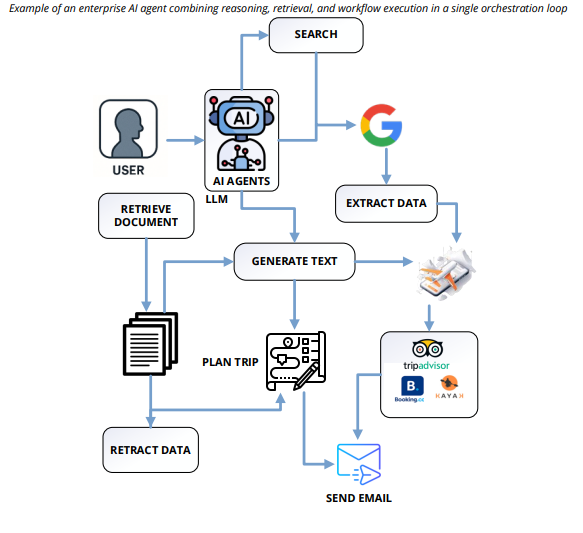
Agentic AI extends beyond conversation to combine reasoning, memory, and action. Such systems perceive goals, decompose them into logical steps, and interact with digital environments through APIs or workflow tools. Recent implementations illustrate this shift:
➢ Azure AI Foundry Agents enable models to trigger downstream actions such as database queries and document generation.
➢ OpenAI’s function-calling APIs allow models to execute multi-step reasoning under controlled guardrails.
➢ Anthropic’s Claude 3 Opus demonstrates reflection and self-evaluation in task planning.
Together, these advances mark the emergence of AI systems evolving from “What shall I answer?” to “What must I accomplish?
ENTERPRISE RELEVANCE
The strategic value of Agentic AI lies in orchestration. For example, a procurement agent can retrieve supplier data from SharePoint, verify pricing through ERP APIs, generate a purchase order, and initiate finance approval—without human intervention. Through such coordination, AI shifts from being an interface to becoming an active participant in enterprise workflows, capable of sensing, deciding, and acting under defined policy constraints.

ANATOMY OF AN AI AGENT
The shift from conversational assistants to autonomous agents represents a fundamental re-architecture of digital intelligence. An AI agent is not a single model but a system that combines perception, reasoning, action, and memory under governed control. Together, these components form a continuous loop that enables the agent to interpret its environment, plan responses, and act responsibly within enterprise systems. Conceptually, an agent operates through a perceive– reason–act cycle, mirroring the structure of intelligent behaviour described in classical agent theory (Russell & Norvig, 2022).

In practice, these capabilities align with four architectural layers. The perception layer captures structured and unstructured data, converting it into embeddings for contextual understanding. The reasoning layer, orchestrated through frameworks such as LangChain or Semantic Kernel, plans and evaluates actions. The action layer executes these plans via workflow automation tools like Azure Logic Apps, while the memory and governance layer maintains continuity, enforces policies, and records decisions to ensure transparency and control. Many enterprise agents blend Retrieval-Augmented Generation (RAG) for real-time knowledge with fine-tuning for domain precision, combining adaptability with expertise.
An AI agent, therefore, represents the convergence of analytics, automation, and cognition—an architecture designed to act intelligently while remaining governed, explainable, and accountable.
ARCHITECTING MULTI-AGENT SYSTEMS
Designing a single agent is an engineering task; designing systems of agents is an architectural discipline. In enterprise contexts, multi-agent systems (MAS) coordinate specialised workers— policy checkers, data retrievers, planners, explainers—so that complex goals are achieved through division of labour and structured cooperation.
Mature implementations depend not on the power of any one model but on the governance of collaboration—the rules that define how agents share context, resolve conflicts, and transfer authority. MAS can be structured in different topologies. Hierarchical designs place a coordinator agent above domain specialists, offering control but risking bottlenecks. Cooperative models allow peers to plan and critique together, increasing creativity while requiring consensus rules.

Market-based systems allocate tasks dynamically through scoring or bidding mechanisms. Most enterprises adopt hybrid forms, using hierarchical control for compliance and cooperative loops for innovation.
Regardless of topology, effective coordination depends on a shared communication contract— standard message schemas, bounded tool access, and reliable orchestration. Central workflow engines manage concurrency, retries, and state, ensuring that conversations among agents remain consistent and recoverable. The orchestrator functions as the system’s control plane, enforcing policy gates and preserving auditability.
A well-architected MAS operates within clear boundaries: each agent has a defined role, auditable actions, and measurable outcomes. Security and governance are embedded through least-privilege access, content filtering, and traceable decision logs. Success is measured not by autonomy alone but by how effectively agents collaborate to achieve goals under policy constraints—balancing creativity with compliance.

RESPONSIBLE & RELIABLE AI IN AGENT DESIGN
As AI systems evolve from isolated models to interconnected agent networks, the need for responsibility, transparency, and reliability intensifies. Enterprises must treat these systems not as experiments but as autonomous actors whose decisions affect business, compliance, and reputation. In this context, Responsible AI is not a policy layer but a core engineering discipline guiding design, execution, and oversight. Responsibility in agentic systems extends beyond data to behaviour—how agents reason, choose tools, handle sensitive information, and manage uncertainty. Frameworks such as Microsoft’s Responsible AI Standard v2 and NIST’s AI Risk Management Framework highlight the need for traceability, human oversight, and governance embedded by design rather than applied retroactively.

Responsible agent design is built on four interlocking safeguards. Content filtering prevents misuse before actions are executed. Policy evaluation enforces organisational rules as code. Logging and observability record every decision for auditability. Human-in-the-loop oversight ensures that critical actions remain subject to human review, preserving accountability without compromising efficiency. Reliability bridges ethics and operations. A system that fails frequently is as damaging as one that misbehaves predictably. Reliability engineering, therefore, includes resilience, rollback, and verifiable execution—ensuring that even when an agent fails, it fails safely. In mature enterprises, reliability and responsibility converge: every autonomous action must be verifiable, reversible, and reviewable, transforming AI from a black box into a glass box—transparent, auditable, and aligned with organisational values

THE ROAD AHEAD: INTELLIGENT ENTERPRISES
The agentic paradigm is redefining what intelligence means within modern enterprises. Where earlier digital transformation focused on process automation and dashboards, the next frontier centres on autonomous collaboration between humans and AI agents that reason, decide, and act as part of an integrated ecosystem.
Unlike traditional automation, which follows linear workflows, agentic systems evolve into ecosystems of reasoning entities that learn, share, and adapt. Each agent contributes contextual judgement rather than isolated output, transforming procedural automation into cognitive collaboration. The hallmark of the intelligent enterprise is not the size of its data lake but the interoperability of its reasoning agents, enabled by secure orchestration and shared context. The rise of intelligent enterprises does not diminish human agency—it amplifies it. As routine cognition becomes automated, humans shift toward strategic oversight, ethical arbitration, and creative synthesis. Studies such as McKinsey (2024) show that organisations integrating AI copilots across business functions achieved up to 45% productivity gains when paired with clear human review boundaries. True intelligence emerges not from autonomy alone, but from alignment between human judgement and machine reasoning.
Achieving this synthesis demands adaptive infrastructures built on knowledge graphs, real-time vector retrieval, and policy-embedded governance. By 2030, enterprise AI maturity will be defined not by the number of models deployed but by how intelligently they are orchestrated. Agentic architectures reinforced by Responsible AI principles will make systems adaptive, explainable, and self-improving. When humans and agents reason together—monitoring, justifying, and learning collaboratively—organisations move beyond being merely AI-enabled to becoming AI-structured: ecosystems where learning, compliance, and innovation coexist in real time.
“The measure of progress in AI will no longer be how well machines mimic humans, but how well humans and machines think together.”
REFERENCES
Anthropic (2024). Claude 3 Opus Technical Overview.
Gartner (2024). Intelligent Enterprise 2030: Orchestration over Automation.
McKinsey & Company (2024). Generative AI and the New Productivity Equation.
Microsoft Corporation (2024). Responsible AI Standard v2 – Engineering for Safety and Transparency. OpenAI (2024). MCP Framework and Function Calling for Agentic Systems.
Russell, S., & Norvig, P. (2022). Artificial Intelligence: A Modern Approach (4th ed.). Pearson.
Wooldridge, M. (2020). An Introduction to Multi-Agent Systems (2nd ed.). Wiley.